
Testing an HVAC Fan Motor Sample: What to Check Before You Order
Check an HVAC fan motor sample in your own assembly: compare airflow and power, try the intended controller, and confirm what will change before production.
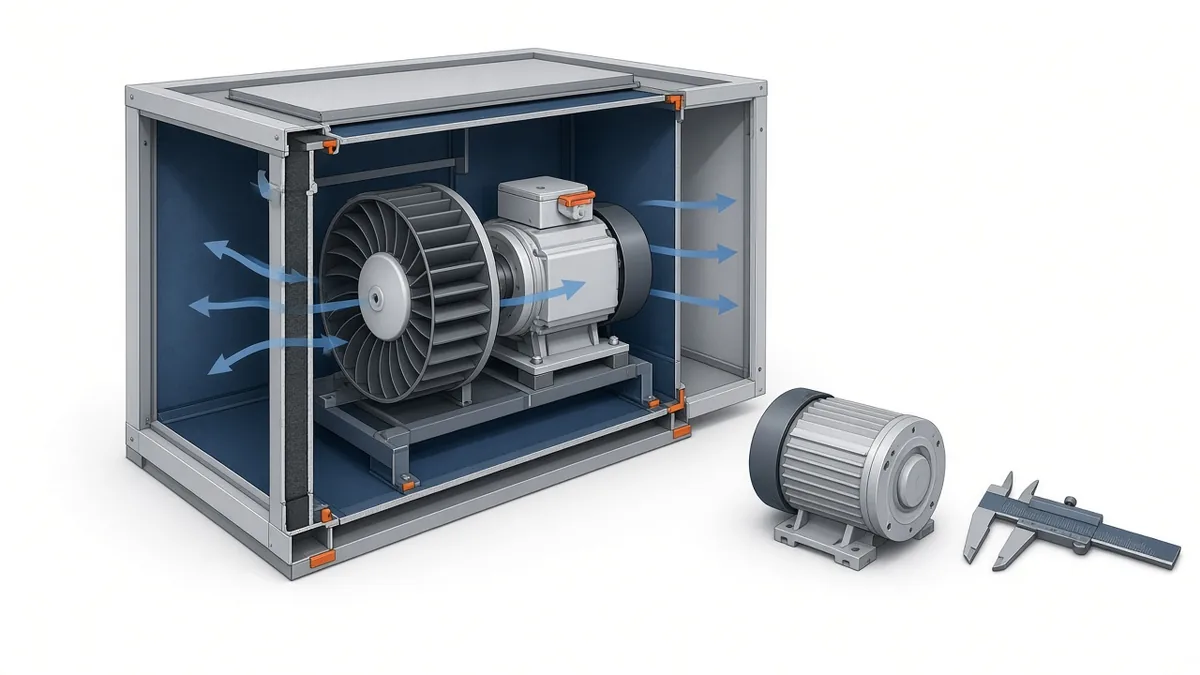
A motor running on a bench tells you little about how much air it will move in your unit. Before placing a production order, try the sample with the wheel, housing, and controller it will actually use.
For an OEM replacing an existing motor, the useful question is specific: can this sample deliver the airflow your unit needs, in the space available, with the controls already selected?
Start inside the cabinet
Fit the intended impeller and mount the motor as it will sit in the unit. Check shaft engagement, wheel clearance, and room for the connector and cable bend. A motor that fits by itself may leave too little room once the wheel and harness are installed.
Use the intended inlet and outlet arrangement, including nearby panels, guards, and filters where fitted. An open-bench setup leaves out restrictions and airflow disturbances that can change fan performance. If the final cabinet is not available, note what is missing from the test setup rather than treating the airflow result as a finished-unit result.
Have qualified personnel run powered tests with the necessary electrical protection and guards in place.
Make the comparison fair
When comparing the sample with the current motor, keep the wheel, housing, air-path components, and supply conditions the same. Use the same measurement locations and method for both tests.
For a power comparison, check both assemblies at the required airflow and pressure—not just at the same speed command. Lower input power is not an advantage if the fan is also delivering less air. Write down airflow, pressure, RPM, and input watts together so the result is clear.
Measure electrical power at the same point for both assemblies. If one reading includes the drive and the other does not, they are not directly comparable. Likewise, an airflow result describes the motor-and-fan assembly in that setup, not the motor alone.
Listen at the operating settings the equipment will use, from the same position for each test. If a new sound appears, check wheel clearance and mounting before assuming it comes from the motor itself.
Use your equipment’s controller
A sample responding to a bench speed control does not show whether it works with your selected controller. Connect the intended controller and try the normal operating sequence: start, low setting, higher settings, and stop. Does the fan start at the lowest intended setting? Does it respond to each command as expected?
For EC/BLDC designs, confirm the specified control input and settings for that particular drive. Do not assume two motors accept the same signal because both are described as EC. For a PSC motor, use its specified capacitor and switching arrangement instead. The FCU motor guide covers these specification choices in more detail.
What changed while you were testing?
If you adjusted a bracket, changed the wheel position, or used a temporary controller setting to get the sample working, tell the supplier exactly what changed. Photos and a marked-up drawing can make that conversation more useful than saying the sample “passed.”
Before ordering, ask whether the production motor will match the tested sample, including its shaft, mounting, harness, and drive settings where applicable. If a part or setting will be different, agree which checks need to be repeated. Keep the sample identification and the final drawing together so purchasing is ordering the version engineering actually tested.
To discuss an OEM application, send MYSUN POWER your motor requirements, along with the wheel and housing details you have available.
---
Discuss an OEM application
Send MYSUN POWER your motor requirements, along with the wheel and housing details you have available.