
Why Standard Catalog BLDC Motors Fail in High-Torque Geared Industrial HVAC
Why catalog BLDC motors fail in high-torque geared HVAC: operating point, temperature rise, gearbox fit and start torque, with a design-review matrix.
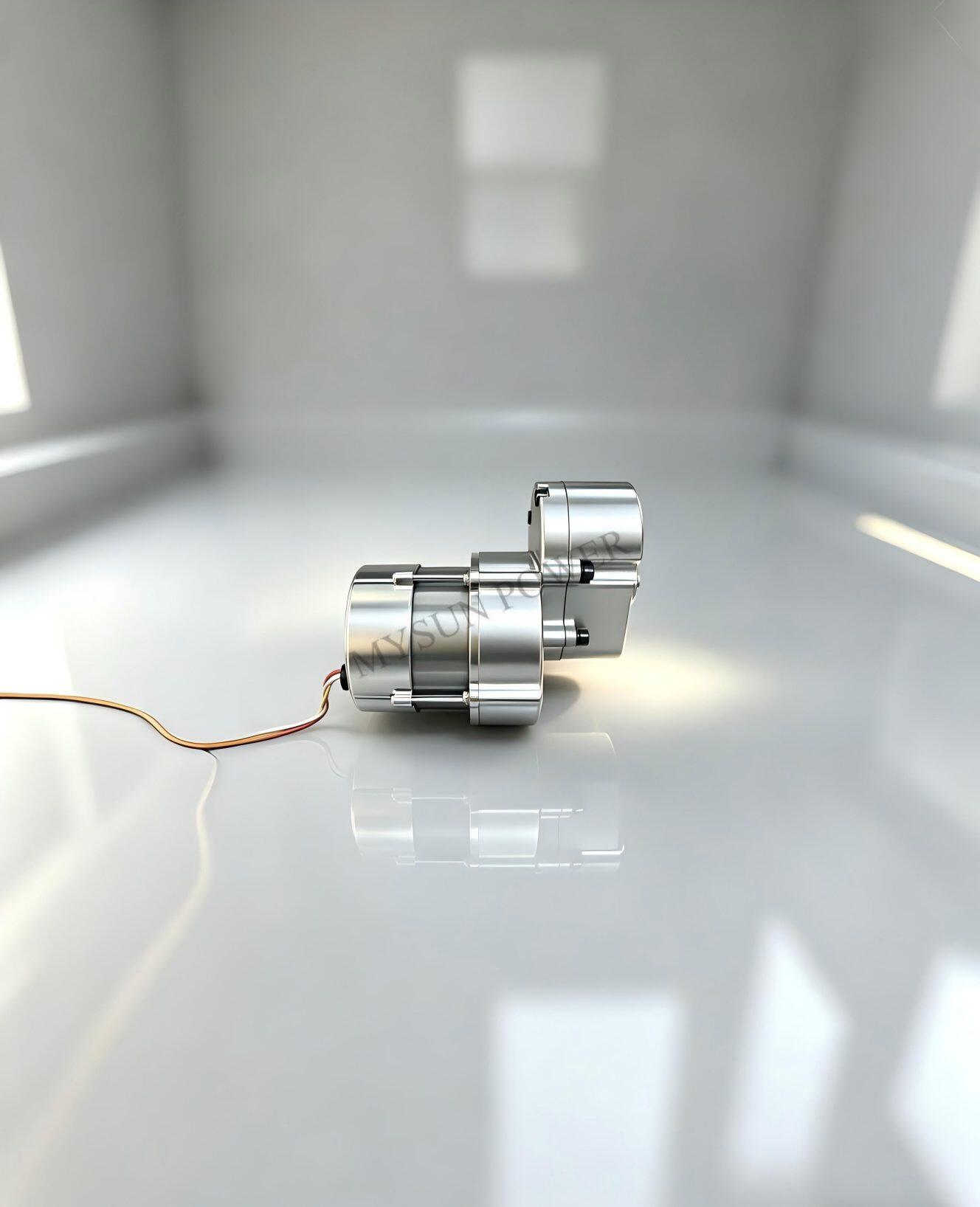
A geared drive in an industrial air handler, damper actuator or heavy exhaust fan rarely fails on the first day. It fails after the motor has been chosen from a catalog page because the voltage, frame and nominal torque looked close enough. The symptoms show up later and in a predictable order: the motor runs hotter than the datasheet suggested, the controller starts current-limiting at start-up, the motor shaft and the gearbox input fight each other through an adapter nobody planned for, and the project goes back to the drawing board for another sample round.
This note is written for HVAC OEM engineers and procurement teams specifying brushless DC (BLDC) or geared drives where the output side runs at high torque. It explains where a catalog motor usually breaks down in this duty, gives a comparison matrix you can use in a design review, and lists what to send a motor supplier so the first prototype is evaluated against your real operating point instead of a generic one.
Why "close enough" stops working in high-torque geared HVAC
A catalog BLDC motor is defined by the conditions its maker tested it under: one supply voltage, one mounting attitude, one ambient temperature, usually free air, and a rated point somewhere in the middle of its torque-speed curve. A geared HVAC drive changes almost every one of those conditions at once.
- The operating point moves. A gearbox multiplies torque and divides speed, so the motor runs where the gear ratio puts it, not where the catalog rated it. If that point sits far from the motor's efficient region, the same output demands more current, and copper loss rises with the square of current.
- The thermal environment is not the test bench. A motor mounted inside a cabinet, behind a fan scroll or outside the airstream loses the cooling it was rated with. Winding temperature, not nameplate torque, sets how long the motor will hold its output in continuous duty.
- The start is the hardest moment. High-inertia fan wheels and loaded dampers demand breakaway torque at near-zero speed. A controller sized for the running point may hit its current limit before the load moves, which looks like a "weak motor" in the field.
- The mechanical interface is fixed by someone else. The gearbox input bore, keyway, flange pilot and bolt circle are defined by the gearbox supplier. A catalog shaft that is close but not matched needs a coupling or adapter plate, which adds length, adds a misalignment path and moves load onto the motor bearings.
None of these are exotic failure modes. They are the ordinary result of putting a part designed for an average duty into a specific one, and they are why a sample that "worked on the bench" can still fail an endurance run in the customer's unit.
Catalog motor vs. application-built motor: a design-review matrix
Use the table below as a checklist when comparing a catalog option with a motor built around your drive. The right-hand column is what should be agreed in writing before a prototype is cut.
| Review item | Typical catalog BLDC motor | Application-built motor | What to define in the specification |
|---|---|---|---|
| Torque-speed operating point | Rated at one point chosen by the motor maker; gearbox duty may land elsewhere on the curve | Winding and magnetic design chosen so the most frequent operating point after the gear ratio falls in the efficient region | Output torque and speed at the gearbox, gear ratio, the most frequent duty point and the peak point |
| Start-up / breakaway torque | Often only rated torque is published; start behaviour depends on the controller you pair it with | Breakaway torque and controller current limit reviewed together | Load inertia, breakaway torque, acceleration time, allowed start current |
| Temperature rise and thermal margin | Stated for the maker's test conditions (ambient, mounting, airflow) | Evaluated for your installation: enclosure, airflow across the housing, ambient range, duty cycle | Ambient range, cooling airflow or lack of it, duty cycle (continuous, intermittent, start/stop rate), insulation class required |
| Shaft-to-gearbox interface | Standard shaft diameter, length and keyway; adapter or coupling may be needed | Shaft, keyway, pilot and flange made to the gearbox drawing | Gearbox input drawing: bore, key, pilot diameter, bolt circle, allowable runout |
| Bearing loads | Bearings selected for a general radial/axial load case | Bearing and housing checked against the actual radial and axial loads from the gear train and fan | Radial and axial loads, mounting orientation, expected service life target |
| Control interface | Whatever speed command and feedback the catalog driver offers | Speed command, feedback and fault signals matched to the HVAC controller | Supply voltage and tolerance, speed command type, feedback and alarm signals needed |
| Enclosure protection | One IP level for the catalog frame | Sealing method (dust seals, O-rings, potted housings) selected for the installation; IP verified against the project's mechanical specification | Dust, moisture, condensation and wash-down exposure; required IP rating |
| Certification scope | Whatever the catalog part carries, if anything | Applicability to the custom configuration and to your end equipment confirmed during project review | Target markets and the certification your end equipment needs |
If most rows in the middle column are acceptable for your unit, a standard motor may be the right buy. The application-built route earns its cost when two or more rows are not.
Where the cost actually lands
The unit price of a catalog motor is visible on the purchase order. The costs of a mismatch are spread across other budgets and are easy to miss in a quotation comparison:
- Extra hardware. Adapter plates, couplings, spacers and sometimes a larger frame bought to recover torque margin.
- Extra engineering time. Bracket redesign, controller re-tuning to stop nuisance current-limit trips, and additional thermal tests on the end unit.
- Extra sample rounds. Each round means new parts, a new test run and another wait before the unit can be released.
- Energy at part load. A motor oversized to survive the start runs far from its efficient region for the rest of the day.
- Field returns. Overheated windings, worn bearings and gearbox input damage tend to appear after commissioning, when they are most expensive to fix.
How large each item is depends on your unit, volume and duty cycle, so we do not quote a generic saving percentage here. If you want to put numbers against these items, the BLDC procurement TCO guide gives a worksheet with the formulas.
What a supplier needs from you before the first prototype
Most re-work in geared HVAC projects traces back to a specification that described the motor but not the drive. Before the first prototype, a motor supplier should be able to answer six groups of questions from your documents:
- Supply and current limits: nominal supply voltage, tolerance, and the maximum current your controller or power stage allows.
- Load curve: output torque vs. speed at the gearbox, gear ratio, breakaway torque, load inertia and the duty point where the unit spends most of its hours.
- Thermal boundary: ambient range, mounting location, whether the motor sees any airflow, and the duty cycle.
- Space and mass: the envelope available and any weight limit.
- Environment: dust, humidity, condensation, chemical exposure and required IP rating.
- Control: speed command method, feedback and alarm signals, and the controller's switching strategy if the drive is yours.
The OEM BLDC customization checklist goes through these fields in more detail.
How MYSUN POWER handles high-torque geared HVAC projects
Guangdong MYSUN Power Technology Co., Ltd. develops custom BLDC and AC motors for commercial and industrial HVAC OEMs, with motor-industry experience since 2010. Our most cost-competitive power range is 100W–1kW, and we support high-torque geared motor applications at 50Nm and above for commercial and industrial equipment. The relevant product families are listed under high-torque planetary and geared motors and brushless DC motors; fan-side applications are covered on the industrial fan motor solutions page.
What you can expect from the engineering side, as stated on our support page and about page:
- Engineering proposal: typically about 14 days when common materials apply, and up to about 30 days when non-standard materials are required. Prototype manufacturing time is confirmed separately after engineering review.
- Prototype and production quantities: an initial prototype batch of 3–5 units for R&D validation; production MOQ from 300 units.
- Customization scope: shaft dimensions, mounting configuration, winding specification, insulation class, cooling method, and options such as encoders, brakes or special coatings.
- Testing: every motor is Hi-Pot tested, with dynamometer testing on samples and prototypes. Our testing uses dynamometers and electrical performance analyzers, and test reports and efficiency curves are provided for confirmed configurations.
- Quality system and certification: manufacturing runs under an ISO 9001 certified quality management system. Selected AC induction motor models (X9674-115.2, X9674-115.2-AL, X1441-115.2, X1441-115.2-AL) hold Intertek cETLus component recognition, Control No. 5020003, tested to UL 1004-1, UL 1004-3 and CSA C22.2 No. 100. That recognition does not automatically extend to custom BLDC or geared configurations; certification applicability for a custom motor and for your end equipment is confirmed during project review.
Send your geared HVAC duty for an engineering review
Share output torque and speed at the gearbox, gear ratio, supply voltage, ambient range and duty cycle. We will review whether a standard motor is enough or what needs to change, and come back with an engineering proposal.
Submit RFQ: High-Torque Geared HVAC Motor →
Already have a gearbox interface drawing or a sample to match? Use the separate drawing channel: Upload drawing for review.
Need the specification template first? Request the Custom Motor Design Form.
More HVAC integration notes: HVAC Motor Integration articles.
Ready to Optimize Your Motor Performance & Lower TCO?
Guangdong MYSUN Power Technology Co., Ltd. delivers customized BLDC, AC, and high-torque geared motor solutions tailored to your thermal, mechanical, and efficiency specs. Engineering proposals in 14–30 days; prototype batches (3–5 units) and production timelines confirmed following engineering review.