Specifying 100W–1kW Motors for Commercial Inline Duct and Fresh-Air Fans
Specify 100W–1kW motors for commercial inline duct and fresh-air fans: installed static pressure, thermal limits, and the production controller.
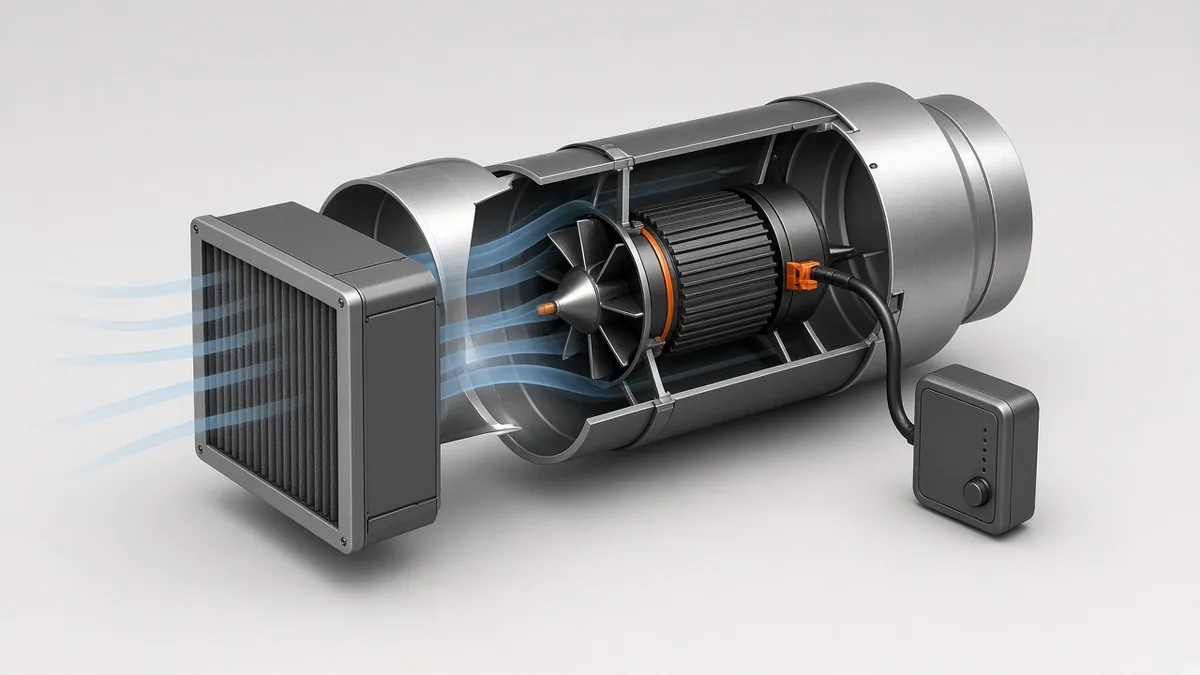
Selecting an inline duct or fresh-air fan motor from free-air ratings or an older nameplate wattage routinely leads to missed airflow targets or thermal shutdown once installed. For commercial and industrial ventilation units in the 100W–1kW range, three baselines determine whether a motor will hold up in production: installed static pressure, thermal limits, and production controller compatibility.
Define airflow at installed static pressure
Specify target airflow at the actual operating static pressure, and state which components sit inside that test boundary (housing, filter, heat-recovery core, silencer, or grille). Include the loaded-filter pressure expected between service intervals, along with inlet and outlet duct geometry if elbows or abrupt transitions sit close to the fan.
If the unit requires constant-airflow compensation as filter resistance builds, call it out as an explicit EC control function rather than assuming standard EC speed regulation covers it. When benchmarking candidate motors, keep the impeller and housing fixed and log airflow, static pressure, RPM, and electrical input power at the same operating points.
Lock down mechanical fit, thermal limits, and moisture exposure
Provide the available length and diameter envelope, mounting pattern, lead exit position, rotation direction (with the viewing end stated), and the exact impeller interface (shaft dimensions or external-rotor mounting geometry).
For airstream-cooled motors and integrated drives, verify winding and electronics temperatures at the lowest continuous operating speed and under restricted-flow conditions alongside the nominal duty point. Peak thermal stress often develops at low-airflow, high-resistance points rather than at top speed.
For outdoor-air intakes and humid exhaust streams, define the actual exposure: ambient humidity, condensation risk, splashing, or washdown procedures. Confirm protection separately for the stator, electronics, and wire entries, including condensation handling beyond a basic IP rating.
Validate with the production controller and housing
Test samples with the ventilation controller the unit will ship with. Confirm the input signal type (0–10 V, PWM, or discrete speeds), signal range, control polarity, wiring pinout, and missing-signal behavior. Control logic varies widely across EC platforms, a compatibility check also detailed in our FCU motor specification guide.
Measure acoustics inside the production housing at occupant-relevant speeds with representative inlet and outlet restrictions. Bench noise levels rarely predict installed tone, structural resonance, or low-speed drive whine under load. For a structured comparison across candidate samples, follow our motor sample-testing guide.
What to send for an engineering review
To narrow down the mechanical frame and build an initial proposal, send the parameters you have confirmed so far:
- Fan type (axial, mixed-flow, or centrifugal) and housing dimensional limits
- Target airflow at static pressure (nominal and loaded-filter), with test boundaries defined
- Supply voltage, frequency, and regional certification needs (such as cETLus applicability for selected North American AC models)
- Speed-control signal, missing-signal response, and lead or connector requirements
- Mounting drawing, shaft or external-rotor interface, and rotation direction
- Operating temperature range and moisture or condensation exposure
- Current motor drawing or nameplate (for drop-in replacements)
Mark any undecided items clearly. Our engineering team uses these inputs to confirm mechanical fit and prepare an engineering proposal, typically within 14 days for common materials or up to 30 days when non-standard components are required. Once the baseline aligns with your unit, MYSUN POWER supports 3–5 prototype units for validation inside your production housing.
Explore MYSUN POWER’s inline duct and fresh-air fan motor solutions, review our RFQ-to-prototype process, or send your drawings and duty points to start an engineering evaluation.
Discuss an OEM application
Send MYSUN POWER your motor requirements, along with the wheel and housing details you have available.