How to Read North American Motor Marks for HVAC Projects: cETLus Recognized vs UL Listed
A procurement guide to North American motor marks: cETLus Recognized Component vs UL Listed end products, standards scope, and Intertek directory verification.
When sourcing electric motors for commercial heating, ventilation, and air conditioning (HVAC) equipment exported to North America, misinterpreting a safety mark on a component nameplate carries severe commercial consequences. A commercial air handler, rooftop condenser, or exhaust blower arrives on a project site in the United States or Canada, only for the local electrical inspector—the Authority Having Jurisdiction (AHJ)—to red-tag the entire unit.
The installation halts immediately. The equipment builder faces delayed project turnover, contractual penalties, emergency field evaluation fees, or the administrative friction of resubmitting full documentation to the inspection agency.
In most cases, the failure traces back to a fundamental misunderstanding between a Recognized Component mark and an End-Product Listing. Sourcing teams and junior engineering staff frequently spot an Intertek cETLus mark or a UL mark on an internal motor nameplate and assume the entire finished HVAC machine is certified. Alternatively, procurement specifications sometimes rigidly insist on a "UL Listed motor," unaware that fractional and integral motors installed inside factory-built machinery are evaluated as recognized components, not standalone listed appliances.
This guide provides an engineering framework for evaluating North American motor marks, explains why the cETLus mark holds legal parity with UL marks, compares component recognition against end-product listing, outlines what HVAC original equipment manufacturers (OEMs) must still evaluate, and details how to verify motor compliance in the official testing laboratory directories.
The North American Regulatory Framework: OSHA, NRTLs, and the Legal Equivalence of ETL and UL
To specify motors correctly for North American projects, procurement teams must first understand the legal structure governing electrical safety. In the United States, the Occupational Safety and Health Administration (OSHA) requires electrical equipment installed in commercial and industrial workplaces to be certified by a Nationally Recognized Testing Laboratory (NRTL). In Canada, the Standards Council of Canada (SCC) performs the equivalent federal accreditation.
Underwriters Laboratories (UL) was the first testing laboratory recognized by OSHA, which created lasting brand familiarity. However, Underwriters Laboratories is one of several accredited NRTLs. Intertek, which issues the ETL Listed and cETLus Recognized marks, is an OSHA-accredited NRTL under federal regulation 29 CFR 1910.7 and is recognized across all 50 states and Canadian provinces.
Crucially, both laboratories test and certify equipment against the exact same harmonized consensus standards:
- UL 1004-1: Rotating Electrical Machines – General Requirements
- UL 1004-3: Thermally Protected Motors
- CSA C22.2 No. 100: Motors and Generators (the Canadian standard)
The letters on the certification mark denote the accredited testing laboratory that conducted the audit and factory surveillance, not the underlying technical standard. A motor bearing the cETLus Recognized mark has been evaluated by Intertek to both United States standards (UL 1004-1, UL 1004-3) and Canadian standards (CSA C22.2 No. 100). The small "c" at the eight o'clock position designates compliance with Canadian standards, while the "us" at the four o'clock position designates compliance with United States standards.
Demanding an exclusively "UL-marked" motor when a supplier presents a verified cETLus Recognized component mark is a common procurement error. It adds unnecessary lead time and vendor friction without providing any technical or legal difference in safety compliance.
Component Recognition vs. End-Product Listing: The Crucial Engineering Distinction
The most critical compliance distinction is not who tested the motor, but what tier of product was evaluated. Testing laboratories divide certification into two primary categories:
1. Recognized Component (cETLus Component Recognition / UR Mark)
A component mark signifies that a subassembly has been evaluated for safe factory installation inside larger, finished equipment.
When a motor receives cETLus Component Recognition under UL 1004-1 and UL 1004-3, the testing laboratory evaluates internal safety characteristics:
- Thermal endurance of the magnet wire insulation system
- Dielectric withstand (Hi-Pot) under high voltage stress
- Mechanical construction of stator laminations and rotor assemblies
- Internal thermal protection coordination (such as automatic reset thermal overload switches)
- Grounding path continuity and resistance to electrical fire hazard
However, a recognized motor is considered an incomplete electrical product. It is not designed to be purchased off a distributor shelf and wired directly into a building power supply by an electrical contractor.
Every Recognized Component carries documented Conditions of Acceptability (CoA) in its official test report. These conditions define the operating boundaries within which the motor remains safe: maximum permitted ambient temperature, minimum cooling airflow across the frame, supply voltage variation limits, mounting orientation, and branch circuit overcurrent protection.
2. Listed End-Product (cETL Listed / UL Listed)
A listing mark indicates that a complete, standalone product has been evaluated for field installation in compliance with the National Electrical Code (NEC / NFPA 70) in the United States or the Canadian Electrical Code (CEC) in Canada.
In the HVAC industry, end-product listing applies to complete machines: packaged rooftop air conditioning units (RTUs), custom air handling units (AHUs), commercial chillers, and ducted fan coil units. These finished systems are evaluated against end-product safety standards, historically UL 1995 (Heating and Cooling Equipment) and increasingly the harmonized standard UL/CSA 60335-2-40.
A field electrical inspector looks for an equipment-level Listing Mark on the exterior unit nameplate. If an AHJ inspects an HVAC unit on a job site and sees only component recognition marks on internal subassemblies (motors, relays, terminal blocks) without an end-equipment listing mark, the unit fails inspection.
What the HVAC OEM Must Complete
Selecting an electric motor with an active cETLus Component Recognition solves a substantial portion of the OEM's compliance testing. Because the motor internal insulation, dielectric boundaries, and thermal protection curves are already proven and monitored under ongoing NRTL factory surveillance, the end-product certifier does not need to dismantle or re-evaluate the motor internals.
However, the HVAC OEM remains responsible for end-equipment compliance:
- In-Situ Thermal Verification: The OEM must verify that the motor winding temperature does not exceed its rated insulation class when operating under maximum design static pressure and elevated cabinet ambient conditions.
- Locked-Rotor Protection: The equipment-level testing must demonstrate that if the blower impeller is locked, the motor thermal protector opens before cabinet insulation or wiring reaches ignition temperatures.
- Mechanical Enclosure & Spacings: Electrical terminations, conduit connections, and live terminal spacings must meet end-product enclosure rules.
- Airflow Cooling: If the motor depends on the airstream for cooling (air-over duty), the equipment design must ensure minimum required face velocity across the motor shell.
Compliance Comparison Matrix: cETLus Recognized Component vs. UL Listed End Product
The following matrix outlines the key regulatory and operational differences between component recognition and end-product listing for commercial HVAC projects.
| Compliance Parameter | cETLus Recognized Component | UL Listed End Product (Equipment) |
|---|---|---|
| Certification Scope | Incomplete subassembly evaluated for factory integration inside finished machinery. | Complete standalone equipment evaluated for direct field connection and operation. |
| Certificate Holder | The motor manufacturer (or affiliated manufacturing group). | The HVAC equipment manufacturer (OEM / system integrator). |
| Visual Mark on Product | Component mark (cETLus recognition mark with "c" and "us" indicators; or UR mark). | Complete Listing mark (cETL Listed or UL Listed mark on the equipment exterior). |
| Governing Standards | Component-level: UL 1004-1, UL 1004-3, CSA C22.2 No. 100. | End-product-level: UL 1995, UL/CSA 60335-2-40, NFPA 70 (NEC), CSA C22.1. |
| Conditions of Acceptability (CoA) | Yes. Test report explicitly documents thermal, electrical, and mechanical constraints. | No. Standalone equipment is rated for installation per standard electrical codes. |
| Job-Site Electrical Inspection (AHJ) | Rejected if installed as a standalone unit; accepted only as an internal subcomponent of listed equipment. | Accepted by municipal and industrial electrical inspectors for permanent building wiring. |
| OEM Engineering Responsibility | Must verify in-situ thermal rise, locked-rotor protection, enclosure spacing, and airflow. | Maintains complete equipment documentation, factory file, and ongoing NRTL factory surveillance. |
| Directory Verification Method | Verified with Intertek by Control Number (e.g. 5020003). | Verified online in UL Product iQ or Intertek Directory under the OEM equipment model number. |
How to Verify Motor Certification with Intertek
Sourcing and compliance engineers must never rely solely on a marketing brochure, quotation sheet, or nameplate photograph when auditing component compliance. Nameplates can be misread, and third-party distributors occasionally conflate component recognition with full listing.
Regulatory compliance officers and procurement teams can confirm current certification status through the Intertek online certification directory:
- Open Intertek's online certification directory, or contact Intertek directly.
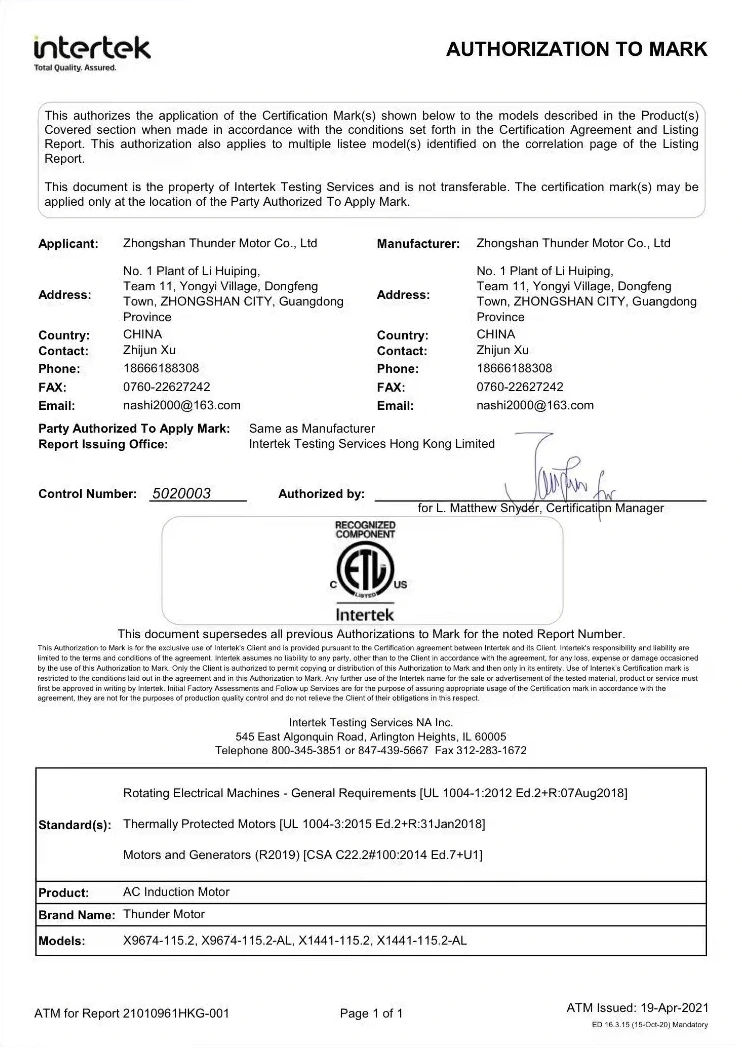
- Search by company name or direct Control Number: 5020003.
- Confirm the authorized manufacturing entity: Zhongshan Thunder Motor Co., Ltd. (中山市雷声电机有限公司), the affiliated manufacturing entity of Guangdong MYSUN Power Technology Co., Ltd.
- Verify the official test report number: 21010961HKG-001.
- Check the evaluated standards: UL 1004-1, UL 1004-3, and CSA C22.2 No. 100.
- Audit the listed models against your bill of materials.
The Intertek directory file for Control Number 5020003 covers four designated AC induction motor models:
- X9674-115.2
- X9674-115.2-AL
- X1441-115.2
- X1441-115.2-AL
If your HVAC fan coil, blower, or commercial ventilation project utilizes these specific AC induction motor frames, the cETLus recognition is active and verifiable for both US and Canadian jurisdictions.
Certification Transparency & Sourcing Guidelines at MYSUN POWER
At Guangdong MYSUN Power Technology Co., Ltd., we maintain strict compliance boundaries across all engineering consultations, drawing on motor-industry experience since 2010 across commercial HVAC and industrial applications.
What sourcing teams and compliance officers need to know about our manufacturing scope, as published on our about page and technical support page:
- Corporate Entity Alignment: Zhongshan Thunder Motor Co., Ltd. and Guangdong MYSUN Power Technology Co., Ltd. are affiliated companies under common ownership, sharing integrated production facilities, testing laboratories, and engineering teams.
- Strict AC Model Scope: The cETLus Component Recognition under Control Number 5020003 strictly covers the four designated AC induction motor models: X9674-115.2, X9674-115.2-AL, X1441-115.2, and X1441-115.2-AL. For commercial blower and ventilation applications, review our AC induction motors catalog and our guide to single-SKU dual-voltage HVAC motor supply chains.
- Custom Configurations & Project Review: cETLus Component Recognition does not automatically extend to custom brushless DC (BLDC) motors, custom wound stators, or precision geared motor assemblies. Certification applicability to custom motor configurations and end equipment must be evaluated and confirmed during initial engineering project review. When custom development is necessary, compare technical parameters in our standard vs. custom BLDC motor selection guide.
- Quality Management & In-House Testing: All motor manufacturing operations run under an ISO 9001 certified quality management system. Production motors undergo Hi-Pot dielectric insulation testing before dispatch, and dynamometer performance testing is carried out on samples and prototypes.
- Explosion-Proof Disclaimer: MYSUN POWER does not currently hold ATEX or IECEx certificates for explosive atmospheres. Sourcing engineers working on hazardous location HVAC systems must not specify MYSUN motors for designated explosion-proof zones.
Confirm Motor Certification Scope for Your HVAC Project
Ensure your motor specification aligns with North American electrical inspection requirements before committing to production tooling. Our application engineering team will review your target airflow duty, ambient conditions, supply voltage, and end-product compliance schedule to determine whether our cETLus Recognized AC induction frames apply or outline testing pathways for custom motor configurations.
Submit RFQ: North American Motor Certification Review →
Already have an HVAC cabinet layout, mounting bracket drawing, or motor specification sheet? Use our dedicated engineering channel: Upload drawings for engineering compliance review.
Need to verify Intertek certificate details for your audit file? Request the Certification Scope Verification Document.
Related Technical & Procurement Resources
- Motor Procurement & Selection Articles: Sourcing guides and technical notes for commercial motor procurement.
- HVAC Motor Integration Articles: Technical resources on motor mounting, thermal management, and duct acoustics.
- Single-SKU Global HVAC Motor Supply Chain TCO: How dual-voltage motor strategies can simplify international inventory planning.
- Standard Catalog vs. Custom BLDC Motor Selection Guide: Procurement decision matrix comparing off-the-shelf catalog frames against custom motor developments.
- Why Standard Catalog BLDC Motors Fail in High-Torque Geared HVAC: Engineering notes on thermal rise, gearbox fit, and locked-rotor limits.
- Industrial BLDC Motor Procurement TCO Guide: Evaluating lifecycle operational expenses and motor reliability in mission-critical equipment.
- Motor Factory Testing & Certification Scope: How MYSUN conducts 100% production Hi-Pot testing and prototype dynamometer verification and how to request test records.
Ready to Optimize Your Motor Performance & Lower TCO?
Guangdong MYSUN Power Technology Co., Ltd. delivers customized BLDC, AC, and high-torque geared motor solutions tailored to your thermal, mechanical, and efficiency specs. Engineering proposals in 14–30 days; prototype batches (3–5 units) and production timelines confirmed following engineering review.